
Karol Colonna – thought you might like a story – a wonderful man, a wonderful boss.
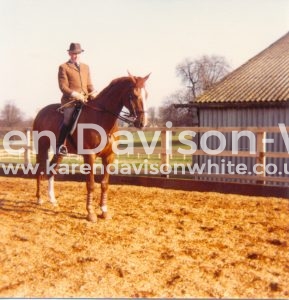
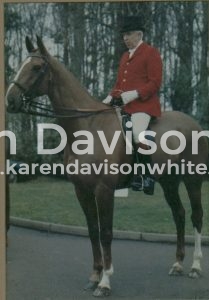
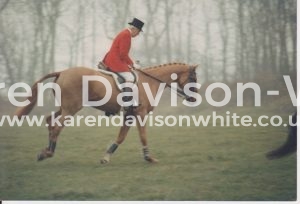
Karol Antoni Colonna-Czosnowski by Karen Davison-White
Known as “The Count” when hunting in Leicestershire, when he rented a hunting box from Col. Hignett in East Langton and hunted with the Quorn, Cottesmore and Fernie in the 1970’s/80’s has gone to that hunting field beyond St. Peter’s gates. He died on 17th October,2015.
From some writings that I treasure from Mr Colonna as “one of the girls” privileged to have worked for him I quote;-
“As for me I pray that there will be horses in heaven. That, when I die my own four-legged friends will be there to meet me. Dandino, Fuzzy, Union Jack, St. Dominic, Claudius, Windmill boy, Tapster Lad, Bitter Ellen, Barnaby, Cain Valley, Yanek and many, many others. All my good hunters and personal friends. And that among them will be the one truly great horse, John O’Gaunt II, the champion eventer.”
John O’Gaunt who had been given to Mr Colonna from Ken Lyndon- Dykes on retirement from his outstanding success with Robert Walker eventing. Was to give The Count five wonderful seasons hunting in the Shires.
In an interview freely available on social media in June this year. Mr Colonna said, “I am certainly not anglicised and nor am I pollicised [sic] I am somewhere in between. When I am in Poland, I am a foreigner who speaks Polish and when I am in England I am a foreigner who speaks English. Basically, I don’t belong anywhere. However, that state of suspension means that I see things that people don’t see.”
Karol Colonna-Czosnowski had an exceptional mind, a font of wisdom; and led the most extraordinary life of which he wrote in a book he published called “Beyond the Taiga” – Memoirs of a Survivor. A true story of a Pole who in September 1939 at the age of eighteen sees his country torn by two synchronised invasions, the Germans flooding in from the West, the Soviets from the East. His home in the East, classified as landed nobility – ‘enemy of the revolution’. His best option was to escape. It failed, he was arrested on the border, accused of espionage, subjected to traumatic interrogation, he ends up in the forced labour camps of the Northern Taiga. He gets struck down by a deadly disease. A Russian woman doctor saves his life and helps him to qualify as a Para-medic.
His medical assignment took him to an ‘all criminal’ camp populated by thieves and murderers. Despite the violent and hostile environment, he manages to assert his authority and soon wins the protection and friendship of the criminal elite.
Freedom comes unexpectedly, the result of the Anglo-Soviet Alliance. He joins the Polish army in the USSR, paradoxically to help the Russians fight the Germans. Eventually, the Poles leave the Soviet Union to join the Allied Forces in the Middle East and, finally, in Italy. As a subaltern tank commander, he fights all the way up to the Italian peninsula, is wounded but survives to witness the Allied victory.
Unable to return to his homeland, by then a part of the Soviet Empire, he settles in England where he sets up in business, despite no contacts and minimal financial reserves. He had a demobilisation gratuity of one hundred and ten pounds as a golden handshake on leaving the forces. Most of which he spent at Messrs. Hobson Bros. of Cork Street, bespoke tailors – investing in three good suits, which he firmly believed would help him in projecting the right image in the lofty boardrooms of the City of London. Then, securing a cubby hole in an attic in a boarding house belonging to a friend of his Aunt who lived in SW1 for thirty shillings a week, established a good address from where to start business. With a battered old Underwood typewriter he began slowly to make contacts, firstly working for a company, then started selling to London confirming houses (by product of the Colonial system). He progressed from buying and selling Italian watches (that were Swiss made) to the South African market and then to iron and steel and owning a very successful company trading between many Nations, including the Eastern Block.
On the 6th November, 1948 Karol Colonna married Marysia Heydel, he had known her since childhood. The marriage proved to be a very happy one, Mrs Colonna always referred affectionately to her husband as ‘Notty’. and they were together for over forty eight years until she died in January 1996. They never had any children.
Mr Colonna progressed in business and after thirteen years he established the business Bishopsgate Steels and along with his partner and efficient Secretary Mrs Tillet, he was able in the 1970’s and 80’s to spend up to four days a week hunting in the Shires, just as his father had told him, should he ever get a chance, he must hunt in England.
Liz Gill (nee Mead) was the back bone of his entire horse operation, first working for him in her early twenties remained with him over forty years. Standards were impeccable, horses produced to perfection.
Colonna bought his first horse in England in 1970 he was aged forty nine. He started with the Surrey Union and did some eight seasons learning the rules, being accepted and remembered joy at being invited to wear their hunt button and the yellow collar. He had two hunters then.
After that he graduated to the Warwickshire where he spent a full season. He had a groom and four horses by then which were stabled in a small yard he hired for the season.
It was then to the Grafton. A friend called Tom Coombs who lived in Sulgrave found him a nice little yard there. He already had a small establishment in Surrey where Liz was his full time groom. Then the Senior Master Col. Neil Foster invited him to preside over some meetings with the prospect of a formal proposal to become a Master. Although flattered by this suggestion he could not consider due to being on a mission to fulfil his dream before too old and hunt with the Quorn.
So a move to Leicestershire ensued; (for the hunters and staff) Mr Colonna commuted from his home in Wimbledon for hunting days and returned in the evening to his business in London. Firstly he moved into Fernie country taking an old Victorian stable block at Illstone-on-the-Hill. Where he installed Liz and her assistant and his eight hunters. He put his name on the waiting list for the Quorn and took to hunting over the green expanses of the foxhunters’ favourite lands.
The following season he moved to the yard at East Langton by which time he was invited to hunt with the Quorn. He had ten seasons with them, and in his book describes not only a particularly wonderful run behind Michael Farrin, riding the great horse John O’Gaunt, it was his chestnut horse Dandino, which was always considered a ‘special horse’ to Mr. Colonna and he shared days with Union Jack. That special horse he bought at four years old and hunted until he was nineteen, when he died in 1987 on the battlefield like a good soldier he was – having by this time moved south and hunting with the Chiddingfold, Leconfield and Cowdray.
Permanent base was Saddlecombe Stud, Headley, near Epsom, which he bought in 1973 and had completely rebuilt by Tony Woodford and celebrated its completion in 1984.
In his hey day Mr Colonna was hunting Monday and Friday with the Quorn, Tuesday with the Cottesmore, Wednesday and Saturday with the Fernie.
In a vague, imprecise sort of way Mr Colonna believed in destiny. He would not be able to describe with any precision, how our destiny operates. But I quote from him:-
“All I have is a nebulous feeling, that things have been written somewhere for each one of us and ‘that which has been written’, cannot be changed.”
In the words of Reggie Paget, describing a memorable day with the Quorn. “Apart from a few sticky patches, a jolly good run”.
A pretty accurate description of Karol Colonna’s life.
HOUNDS MAGAZINE – VOLUME 32 NO. 2 DECEMBER 2015